Someone asked ChatGPT for a recommendation today. Your brand came up, or it didn’t, and you had no idea either way. That’s the blind spot most marketing teams are sitting in right now.
Search has quietly split into two lanes. There’s the blue-link results page, and there’s the growing habit of asking an AI chatbot directly instead.
Pew Research found that 60% of US adults now read AI-generated summaries in their search results, and 49% use AI chatbots outright, up from just 33% in 2024 (Pew Research Center, June 2026). Half the country is getting answers, and possibly brand recommendations, from a source most teams aren’t watching at all.
That’s exactly why so many marketers are hunting for the best ways to track brand mentions in AI search. Rankings alone don’t tell you if your brand is actually being recommended inside a conversation. This guide breaks the process into clear, usable steps.
Best Ways to Track Brand Mentions in AI Search
Tracking brand mentions in AI search isn’t one task. It’s a small system of checks you run consistently. Here’s how to build it.
Step 1: Run Direct Prompts Across Major AI Platforms
Start manually before you automate anything. Ask ChatGPT, Gemini, Perplexity, and Copilot the questions your buyers would ask.
Try prompts like “best [your category] for small businesses” or “top brands for [your product].” Note whether your brand shows up, where it ranks in the answer, and which competitors appear alongside it.
This step is slow, but it gives you a real baseline before you trust any tool’s dashboard.
Step 2: Use AI Visibility Tracking Tools
Manual checks don’t scale past a handful of prompts. This is where dedicated AI visibility tools come in.
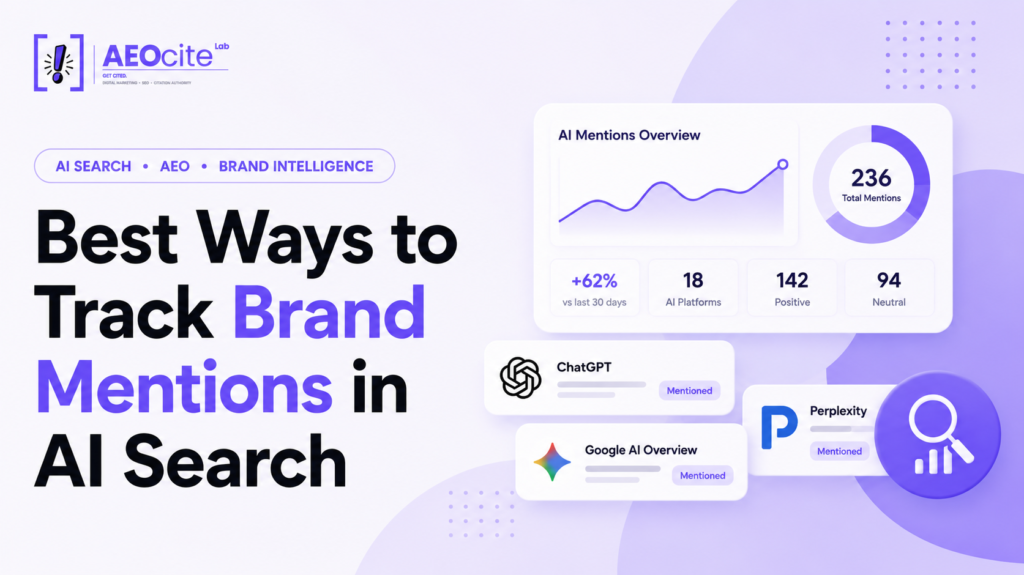
Platforms built for this purpose run hundreds of prompts on a schedule and log every mention across ChatGPT, Perplexity, and AI Overviews. They track share of voice, sentiment, and how often your brand gets cited compared to competitors.
Look for a tool that separates plain mentions from actual citations with a source link attached. That distinction matters more than most dashboards let on.
Step 3: Monitor Citations, Not Just Mentions
A mention is your brand name appearing in an AI response. A citation is your website being linked as the source behind that response.
Citations carry more weight because they drive direct traffic and signal that the model trusts your content. Track which of your pages get cited most often, and which topics trigger those citations.
If you only track mentions, you’ll miss the pages actually doing the work.
Step 4: Set Up Branded and Category Query Tracking
Split your tracking into two buckets. Branded queries include your company name directly. Category queries describe the problem your product solves, without naming you at all.
Branded tracking tells you how AI models describe your company when asked. Category tracking tells you whether you get recommended when a buyer hasn’t heard of you yet.
Most brands only watch the branded bucket. The category bucket is where new customers actually come from.
Step 5: Track Competitor Mentions Alongside Your Own
Tracking your own brand in isolation only tells half the story. Run the same prompts against your top three competitors.
Watch for patterns. Do certain competitors get cited for pricing questions while you get cited for features? That gap points directly to a content opportunity you can fill.
Step 6: Review AI Overviews and Search Summaries Separately
Google’s AI Overviews behave differently from a chatbot conversation. They pull from top-ranking pages and structured data, so they respond more directly to SEO fundamentals.
Track your Overview appearances separately from chatbot mentions. Note which queries trigger an Overview and whether your brand gets pulled into the summary or pushed below it.
Step 7: Build a Simple Weekly Tracking Routine
None of this works as a one-time audit. Set a recurring weekly check that covers three things: new mentions, citation sources, and competitor movement.
Keep it in a simple spreadsheet if you’re not ready for a paid tool yet. Consistency matters more than sophistication at this stage.
Why Manual Checks Alone Aren’t Enough
AI models update their responses constantly, sometimes within the same week. A prompt that surfaced your brand on Monday might not on Friday.
That volatility is exactly why relying on occasional manual checks leaves gaps. A proper AI search tracking process needs to run often enough to catch those swings, not just once a quarter.
Combining manual spot checks with an automated tool gives you both the nuance of real conversations and the scale to monitor dozens of prompts without burning your team’s time.
Final Thoughts
There isn’t one single tool or trick that solves this. The best ways to track brand mentions in AI search combine manual prompt testing, dedicated visibility tools, citation tracking, and a routine you actually stick to.
Treat it as an ongoing habit rather than a one-off project, since AI-generated answers shift more often than traditional search rankings ever did.
Start small. Run ten prompts by hand this week, note what comes back, and build your tracking system from there. If you’d rather skip the trial and error of figuring out how to monitor your brand’s presence across AI tools, AEOcite Lab specializes in exactly this.
Our team runs AI citation tracking, entity optimization, and full AEO and GEO strategy so your brand gets recommended inside ChatGPT and AI Overviews, not just ranked on a search results page.
Talk to AEOcite Lab about building a tracking and visibility plan tailored to your brand.
FAQs
-
What are the best ways to track brand mentions in AI search?
The best ways to track brand mentions in AI search combine manual prompt testing across ChatGPT, Gemini, and Perplexity with a dedicated AI visibility tool. Layer in citation tracking and competitor comparisons for the full picture.
-
How often should I check brand mentions in AI search?
Weekly is the minimum. AI models update their responses often, sometimes within days, so a monthly check misses too much movement to be useful.
-
What’s the difference between a mention and a citation?
A mention is your brand name showing up in an AI response. A citation is your website getting linked as the actual source. Citations matter more because they drive real clicks.
-
Can I monitor AI search mentions without a paid tool?
Yes, at a small scale. Manual prompt testing in a spreadsheet works fine when you’re just getting started. A paid tool becomes worth it once you need to track dozens of prompts consistently.
-
Which AI platforms matter most for brand mention tracking?
ChatGPT and Google AI Overviews carry the most search volume right now, so start there. Add Perplexity and Gemini once your baseline tracking is in place.