Your best page just lost its click. Google answered the question itself, right inside the search results, and the searcher never scrolled down to your link.
That’s the new default for a huge share of searches in 2026. AI Overviews sit above the usual blue links, pull an answer from somewhere on the web, and hand it straight to the searcher. The real question is whether that answer comes from your page or a competitor’s.
Seer Interactive tracked 5.47 million queries across 53 brands. Pages cited inside an AI Overview earned about 120% more organic clicks per impression than uncited pages answering the same question (Search Engine Journal, April 2026). Getting cited isn’t a bonus anymore. It’s the difference between showing up and going quiet.
This guide breaks down exactly how to optimize content for Google AI Overviews, step by step, without the fluff.
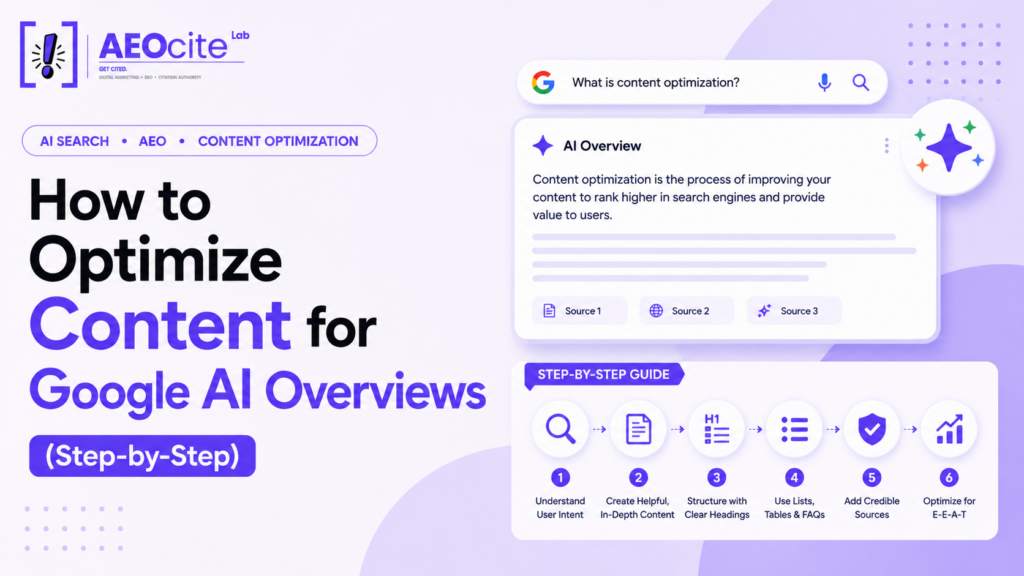
Step 1: Lead With a Direct Answer
AI Overviews pull short, self-contained answers, usually one or two sentences long. Bury your answer under three paragraphs of setup and the model has nothing clean to lift.
Open every important section with the actual answer first. Save the context, caveats, and examples for right after. This single habit does more to optimize content for Google AI Overviews than almost anything else on this list.
Step 2: Build Sections Around One Clear Question Each
People don’t type fragments into AI chatbots. They ask full questions, the way they’d ask a colleague.
Structure your H2 and H3 headings the same way. “Best CRM for small teams” works fine for classic SEO. “What is the best CRM for a five-person sales team” mirrors an actual prompt. Match your subheadings to real questions your buyers ask, and answer each one fully before moving on.
Step 3: Format for Extraction, Not Just Reading
Dense paragraphs are hard for any system, human or machine, to pull a clean answer from. Short paragraphs, numbered steps, and bullet lists give AI models something structured to grab.
Keep paragraphs to two or three sentences in your key sections. Use ordered lists for anything sequential, like a process or a comparison. This isn’t about dumbing down the writing. It’s about making the good part easy to find.
Step 4: Add Schema Markup for Context
Structured data won’t guarantee a citation on its own, but it removes ambiguity for Google’s crawlers. FAQPage schema, HowTo schema, and Article schema each tell Google what type of content it’s looking at.
If your page answers a specific question, mark it up as an FAQ. If it walks through a process, mark it up as a HowTo. This small technical step gives your content a clearer identity in Google’s eyes.
Step 5: Build Topical Depth Around Your Core Entity
A single great post rarely earns a citation by itself. Google favors pages that sit inside a site clearly built around the topic, with related pages linking to each other and reinforcing the same entity.
Cover the subtopics your main page can’t fully address, then link them together. Some teams handle this systematically through dedicated AEO services that map entity relationships across an entire site instead of one article at a time.
Step 6: Back Every Claim With a Real Source
Vague claims don’t survive contact with an AI model trying to summarize a topic accurately. Specific numbers, named studies, and dated sources do.
Whenever you state a fact that could be challenged, cite where it came from. Link to the original study, not a secondhand summary of it. The same logic behind the Seer Interactive stat earlier in this post applies to your own writing. Real data earns trust that vague assertions never will.
Step 7: Keep the Page Current and Track Citations
AI Overviews lean toward freshness. A page updated last quarter reads as more trustworthy than one untouched for two years, especially on fast-moving topics.
Set a recurring schedule to revisit key pages, update stats, and fix anything that’s gone stale. Then check whether the work is paying off. Search Console shows impressions, but it won’t tell you if you’re actually being cited inside an AI response.
If building that tracking process yourself feels like a stretch, several of the best AI SEO agencies already run it as a standard service.
Common Mistakes That Block AI Overview Citations
A few habits quietly keep good content out of AI Overviews.
- Burying the answer under a long introduction
- Writing headings for search engines instead of real questions
- Skipping schema markup entirely
- Making claims without a source attached
- Letting high-value pages sit untouched for years
Fixing even two or three of these tends to move the needle fast.
When to Bring in Outside Help
Not every team has the bandwidth to run this process in-house, and that’s fine. A specialized partner can shortcut months of trial and error.
If you’re weighing agencies, our guide on how to choose an SEO agency covers the right questions to ask before signing anything.
B2B brands in particular deal with longer sales cycles and multiple decision-makers, which is exactly the challenge some of the top B2B SEO firms in India are built around.
Final Thoughts
Optimizing content for Google AI Overviews isn’t a one-time project. It’s a habit built from clear answers, tight structure, real sources, and pages that stay current.
Start with the page that gets the most traffic today. Rewrite the opening to lead with a direct answer, add schema, and cite one real source. Then measure whether it gets pulled into an Overview. Small, consistent changes like this compound faster than most teams expect.
If you are someone struggling to get into Google AI Overviews, then contact AEOcite Lab. We are the best AEO and GEO agency in India that can land you directly in AI overviews.
FAQs on How to Optimize Content for Google AI Overviews
-
What does it mean to optimize content for Google AI Overviews?
It means structuring content so Google’s AI can extract a clear, accurate answer and cite your page as the source, rather than just ranking your page on a results list.
-
Is optimizing for AI Overviews different from regular SEO?
Yes, though the two overlap heavily. Traditional SEO chases rankings. AI Overview optimization chases citations, which means answer-first writing, schema, and verifiable sources matter more than keyword placement alone.
-
How long does it take to see AI Overview citations?
Most sites see early movement within a few weeks of restructuring key pages. Consistent citations usually build over two to three months of steady work.
-
Do backlinks still matter for AI Overview visibility?
Yes. Backlinks still signal trust and authority. Pages with stronger backlink profiles tend to get pulled into AI Overviews more often than pages without them.
-
Can small websites get cited in AI Overviews?
Yes. Citation depends more on how clearly a page answers a specific question than on domain size, though established topical authority still helps.