A CFO will not fund a program because ChatGPT mentioned your brand once. She will fund it when you hand her a number she can check. This guide gives you that number.
TL;DR
- The ROI of GEO equals revenue linked to AI visibility, minus total program cost, divided by that cost.
- Clicks undercount the result, so combine GA4 referral data with self-reported attribution and a fixed prompt set.
- Judge the ROI of GEO across six months, because early spend mostly buys access fixes and baselines.
- AEOcite Lab helps brands build the baseline, track citations, and tie them to pipeline.
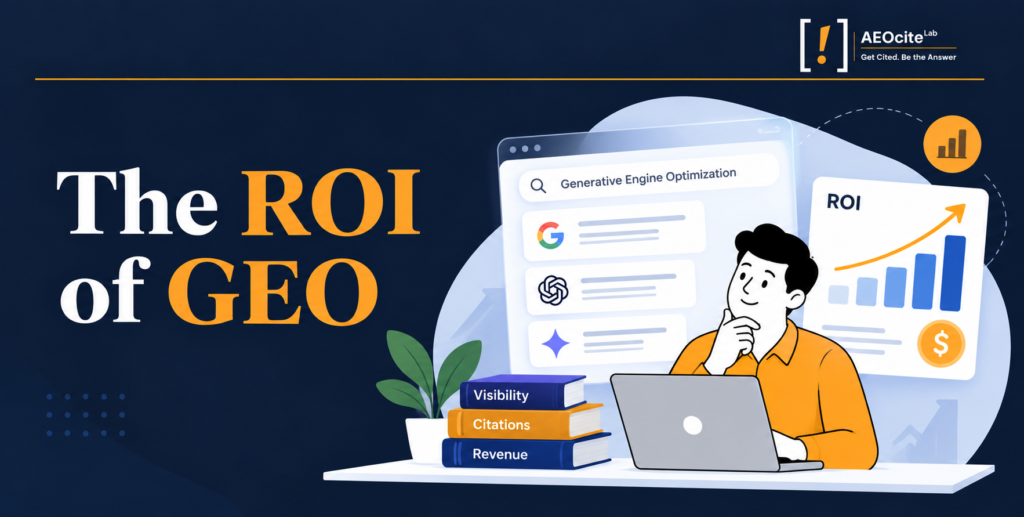
The ROI of GEO is the revenue you can trace to AI-driven visibility, minus what you spent earning it, divided by that spend. The math is simple. The hard part is deciding what counts as revenue when a buyer reads your name inside an answer and types your URL days later.
The effort is worth it. Semrush found that the average AI search visitor is worth 4.4 times more than a traditional organic visitor, measured by conversion rate. Fewer clicks, higher value per click. That makes sloppy measurement expensive.
What Counts as a Return in the ROI of GEO
Three sources of return show up in real accounts. Count all three, or you will undersell the program.
- Direct referrals: sessions from chatgpt.com, perplexity.ai, and similar domains in GA4, plus their conversions.
- Assisted conversions: branded search and direct visits that rise after your citation rate climbs.
- Self-reported leads: people who type “ChatGPT” or “Perplexity” into a “how did you hear about us” field.
The third source is the most underused. It costs one form field, and it often reveals leads that analytics quietly filed under direct traffic.
The ROI of GEO Formula, Worked Through
The formula: (attributed revenue minus total cost) divided by total cost, times 100. Here is an illustrative six-month example for a B2B software company. Swap in your own numbers.
| Line item | Value |
| Agency, content, and digital PR | $30,000 |
| Monitoring tools ($250 x 6 months) | $1,500 |
| Internal time (75 hours at $60) | $4,500 |
| Total cost | $36,000 |
| Qualified leads attributed (direct plus self-reported) | 31 |
| Close rate | 20% |
| Average first-year contract | $12,000 |
| Attributed revenue (31 x 20% x $12,000) | $74,400 |
Spend of $36,000 returned $74,400, so the ROI of GEO lands near 107%. If your sales cycle is long, count open pipeline at a weighted probability instead of waiting for closed deals.
Shared work needs care. A schema fix that lifts both Google rankings and AI citations should not be billed to GEO alone, and our breakdown of how to split spend between SEO and GEO shows one way to allocate it.
Four Inputs to Track Every Month
-
Citation Rate
Build a fixed list of 20 to 30 buyer prompts and run them across ChatGPT, Perplexity, and Google AI Mode. Record the share of prompts where your brand appears. Answers shift from week to week, so run each prompt twice and average the results. This is your leading indicator, since it moves before revenue does.
If you need a method, see the best ways to track brand mentions in AI search.
-
AI Referral Sessions and Conversion Rate
Create a GA4 segment for AI referrers. Compare sessions, conversion rate, and revenue per session against organic search. Volume will usually look small, so report the conversion gap rather than the visit count alone. Otherwise leadership will dismiss the channel as a rounding error, and your calculation of the ROI of GEO will never get a fair hearing.
-
Branded Demand Lift
Watch branded impressions in Search Console and direct traffic. When citation rate and branded demand rise in the same weeks, you have a credible assist story. Compare against a pre-launch baseline and against seasonality, so a holiday spike does not take credit it has not earned.
-
Fully Loaded Cost
Add agency fees, writers, digital PR, tool subscriptions, and internal hours. Teams that count only the retainer report inflated returns, and finance catches it quickly. Honest cost is what makes the final figure defensible in a budget meeting.
Why the First Quarter Rarely Shows the Full Return
Early months mostly buy groundwork. Months one and two go to crawler access, content restructuring, and baselines. Citations tend to shift in months three and four. Referrals and assisted conversions reach your pipeline by months five and six.
Start with an AI search readiness audit so month one produces a real baseline instead of guesses. Then report on a rolling six-month window. A month-two snapshot will almost always look negative, and that is normal.
Where ROI Calculations Break
The most common error is counting clicks only. AI answers often satisfy the buyer, so the visit never happens, yet your name sticks. Self-reported attribution closes that gap.
The second error is double counting. When one technical fix helps both Google and AI answers, assign the revenue once. Many teams split shared work evenly at first, then adjust as data arrives.
The third is trusting one prompt run. Models can answer the same question differently from one day to the next, so a single screenshot is not evidence.
Final Thoughts
The ROI of GEO is measurable, but only if you decide what counts before the program starts. Set the baseline, log cost honestly, and report on a six-month window.
If you want a partner for the tracking and execution side, AEOcite Lab’s AI SEO services cover both. When comparing vendors, ask how they report returns, and use our guide on how to choose an SEO agency to frame the conversation.
FAQs
-
What is a good ROI of GEO?
No reliable universal benchmark exists yet. Compare it against your paid and organic channels instead. If GEO matches or beats them after six months at honest cost, it has earned its budget.
-
Can I measure the ROI of GEO if AI referral traffic is tiny?
Yes. Combine self-reported attribution, branded search lift, and citation rate from a fixed prompt set. Together they show influence that raw referral counts miss.
-
Does GEO pay off for small businesses?
It can, when the scope stays narrow. Fix crawler access, restructure your top pages, and track 15 prompts. Costs stay low, so even modest returns can clear the bar.